My spiritual search from childhood
Hemabha Jang
Hemabha talks about how she was interested in spirituality from a very young age. After trying many different paths, she explains what drew her to the path of Sri Chinmoy, whilst living in London, UK.
Artist in focus - Vilas Silverton
Vilas Silverton has been a student of Sri Chinmoy for approximately two decades. He is an accomplished artist - cultivating a unique and soulful approach to ceramics. His work has been extensively displayed throughout Great Britain. In this short interview, he talks about some of his artistic inspiration.
Could you tell us a little about your art?
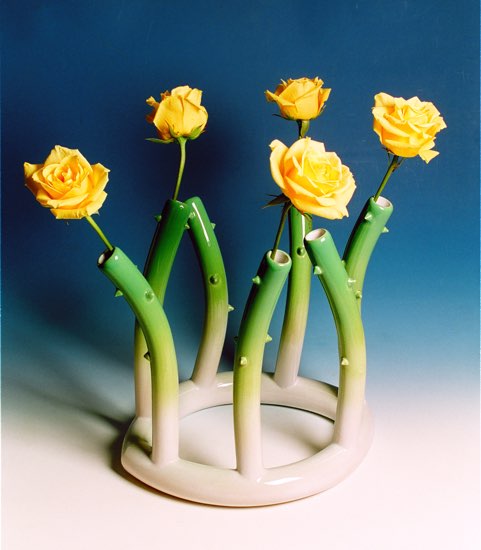
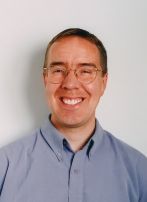 I specialise in Ceramics, but also enjoy painting and drawing. My ceramic work is made up mostly of figures, heads and busts of fictional characters. They come generally from my imagination but refer to artists and styles that inspire me, as well as things I see around me every day. As I am drawn to different influences over time, my work also changes. Yet there seems to be a recognisable style that pervades my output. It is not something I try to control, it just comes out that way.
This is probably because my artistic work comes from a place inside me, and this is a place I am trying to get to know better through my inner life of prayer and meditation. I have been practising meditation actively for over 20 years under the guidance of my spiritual master, Sri Chinmoy.
His approach is to base one’s practice on the spiritual heart, an energy centre in the centre of the chest. I find this to be a place of peace, stillness, love and oneness with others. It encourages a childlike simplicity and spontaneity in my life which then guides and shapes my artwork.
For yourself, what is the link between your art and your spiritual life?
For me, the link between my spirituality and art is everything. When I consciously started on my journey of self enquiry, I realised that if my art had no underlying foundation of deep conviction, it would be only a shallow attempt at producing amusing distractions.

Although my work may appear childlike, I am not trying to be childish. I am committed to producing things that make the world a better, happier place. This conviction comes from deep inside as a result of my spiritual practice but also from seeing unhappiness, misery and suffering around me. I have no desire to comment on society or use my art as an outlet for dissatisfaction and angst. Nor am I inspired to produce representational art, i.e. drawing what I see before my eyes. I am trying to offer a positive contribution to the world by offering things of beauty that do not yet exist on earth. My works come from a realm inside my heart that is both simple and beautiful, happy and positive. It is these aspects that I try to bring to this physical world through my art and life.
To try and make things of value, I treat the making process with utmost respect. I try to meditate before working so that I am in a good space and commit to trying my best. While making I also try to keep thoughts to a minimum with no distractions from the radio or chatting with others. When I finish a session of making, I again meditate. This time I offer my gratitude for the gifts I have received, and I try to unconditionally offer my output to the earth atmosphere for its improvement and peaceful happiness.
What do you hope to achieve/offer with your art?
When I have finished a piece and offered it as mentioned above, I loose my claim on it to determine its role in the world. As a result, I don’t have any set notion of what I hope to achieve with a piece. I realise that fame and fortune do not determine the value of work. For me, the only thing that matters is how successfully I have been able to translate my hearts inner cry into physical form, be it a painting, drawing or piece of ceramics. I can tell if I have been successful in this regard by the joyful feeling I get in my heart when something is good, right and true. If I can offer my goodwill to the world through my artistic output then I am more than happy and grateful for that opportunity.
Who are your main artistic influences?
My main artistic influence has to be the practice of my inner life as mentioned above.
In terms of outer influences, I grew up reading comics and watching cartoons and so I associate that type of art with happy childhood memories. I try to translate this simplicity and clarity of line into my three dimensional work in particular.
My influences in the fine art world are many and varied. For drawing skill I love Degas and Ingres, Daumier and Rembrandt. For power and emotion I love Zurbaran, Goya and Massacio. For playful inventiveness I love Miro for his capacity to transfer his creativity with integrity across Painting, printmaking, Sculpture, Ceramics and beyond.
In the world of Sculpture and ceramics, I am especially fond of the tomb figures of the Japanese Haniwa period. They have a simplicity and charm that I find fascinating and endearing. I am also fond of English 18th Century slipwares that display a warmth and humanity in decoration.
As my interest in spiritual enquiry developed, I started to look more closely at different world traditions and came to love Indian folk art. This includes the ritual objects left under village trees and painted decorations that permeate and enrich living spaces. The themes of simplicity and devotion really capture my heart in such works and inspire me to make works that have a meaningful depth to the best of my ability.
Apart from art, what else do you enjoy doing?
Since my youth I have loved cycling and continue with the sport. Due to some long standing injuries, I have recently changed my focus from racing short distances to riding long distances. This has brought me new perspectives on dealing with life situations and is giving me satisfaction and fulfilment in taking up new challenges. In Sri Chinmoy’s spirit of self-transcendence, I am trying to ride further/faster and yet keep cheerful, positive attitude, even when things get difficult.
- More indepth article on Vilas's artistic inspiration
- Vilas cycling article
Daily aphorisms by Sri Chinmoy
During his lifetime, Sri Chinmoy composed many thousands of short poems and aphorisms, which all relate to aspects of the spiritual life.
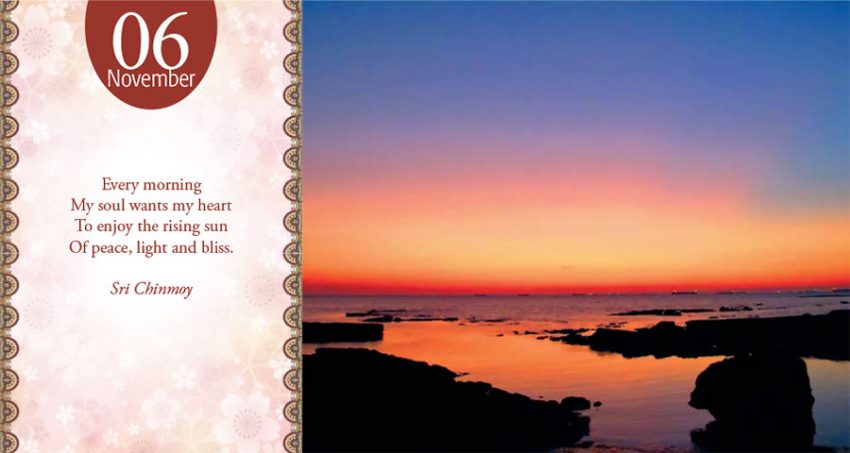
These nuggets of wisdom and inspiration give seekers a thoughtful insight to finding a deeper meaning to life.
At Sri Chinmoy Poetry, we will be publishing a daily aphorism/photo. The photos are from a range of photographers within the Sri Chinmoy Centre.
Follow: Daily aphorism at Sri Chinmoy Centre
They are also published in calender by The Golden Shore.
Samunnati wins Dublin Marathon in personal best time
Samunnati Nataliya Lehonkova (34), a member of the Sri Chinmoy Centre from the Ukraine, recently won the elite women's race of the 2017 Dublin Marathon. Despite testing conditions, Samunnati posted a personal best time of 2.28.57 to take her second win in the Dublin marathon - this was the third fastest time for women that had ever been set in the vent.
Sammunati competed for the Ukraine in the Rio Olympics last year, and has also won marathons in Los Angeles, Belfast and Toulouse.
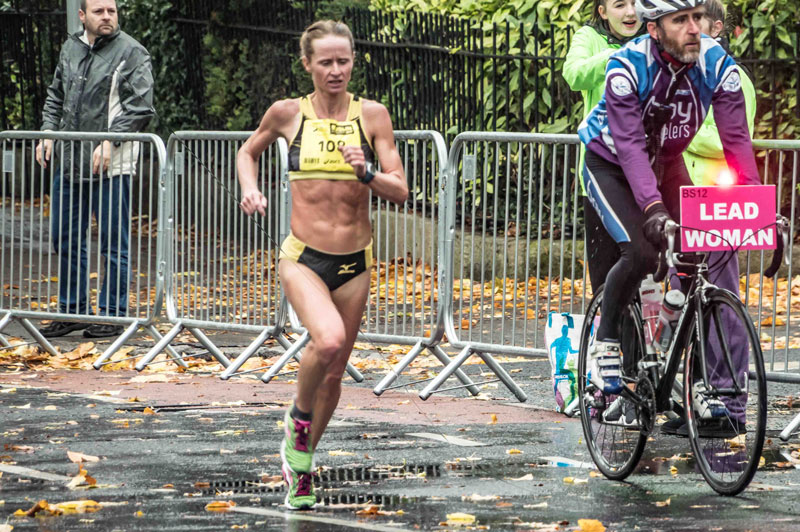
A record 20,000 runners completed the 2017 Dublin Marathon in a course that passed through important landmarks of Dublin including Fitzwilliam Street, Phoenix Park and finishing in Merrion Square.
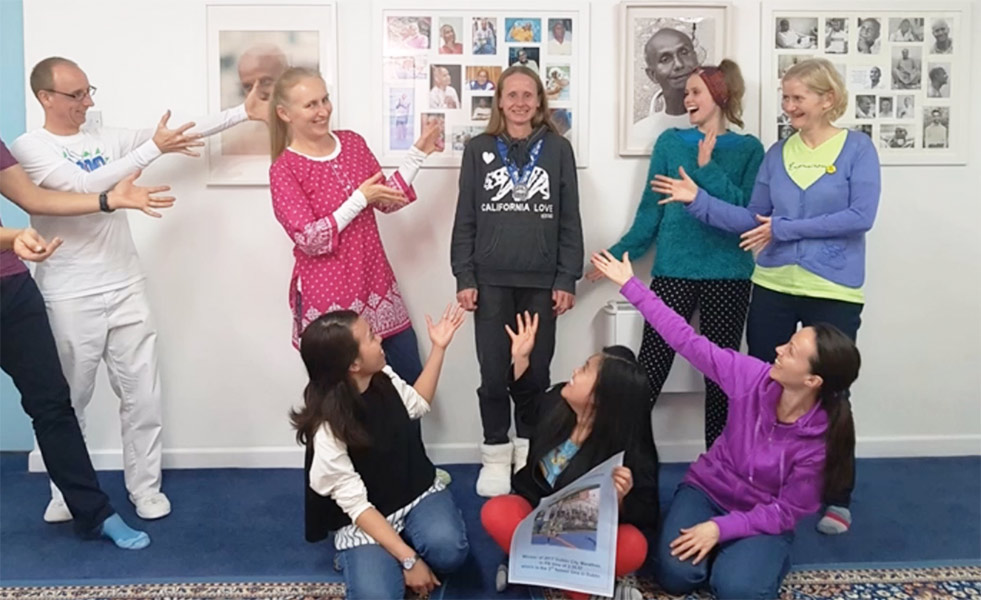
Vilas Silverton on his artistic inspiration
Vilas Silverton from Bristol Sri Chinmoy Centre talks about his art and spiritual life.
I have been inspired in my early years by a huge number of artists, as from most people’s work, there will be something that can be learned and taken as a point of departure for one’s future development.
When I started taking a serious interest in art, I was mostly drawn to the masters of drawing and sculpture. In general, I found most paintings over worked and less vibrant than drawings and sketches. Of course there are always exceptions and Degas, Rembrandt, Van Gogh and Toulouse-Lautrec immediately spring to mind.
The more I visited art galleries, churches and libraries, the more I discovered, and quickly learned to love so called folk art with its directness and honesty as well as medieval painting and sculpture for its combination of terrifying imagery and charming decoration.
In my own work I was continually drawn to sculpture. I reasoned that most of our life is surrounded by objects, so it seemed only natural to make things in three dimensions. Yet I still loved drawing. I tried making preparatory drawings for sculpture, as I had seen in many books yet for me, these drawings rarely helped in the actual production of a sculptural piece. I loved drawing for its own sake and have continued to draw, mostly using simple lines and flat areas of colour with no attempt at describing three dimensional subtleties in terms of light and shadow. I believe that the play of light on my sculptural forms is a much better at this than I am, and so I leave it up to the light.
However, there is another reason why I do not try to show light falling over forms in drawing and painting. I find I need to use my mind too much to try and work out how the light will be falling, and how it will be reflected, and as such I cannot stay centred in the flow of creativity that comes from my heart. This heart-centred approach comes as a direct result of my meditation practice which I will describe shortly.
As I got older and looked at entering Art School, I found that most modern sculpture did not deal with made objects as such, but was heavily drawn towards conceptual art, ideas, statements and appropriating found objects. TV and video were in vogue as sculpture and I shuddered to figure out my place in this world, as I still loved making things to the best of my ability.
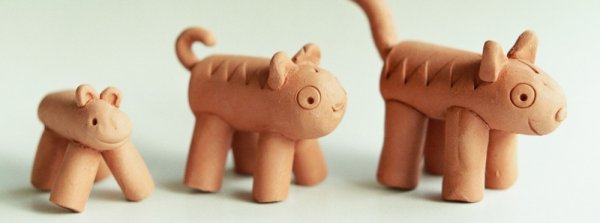
So I looked towards clay and ceramics. I could still make sculptural pieces and learn skills that might allow me to develop. Courses were generally focused on making items for use in the home, but a few students would make figurative and sculptural pieces against the tide of domesticity and industry. I was one of these. Once I had learned to throw on the wheel, and make things by hand in other ways, I finally plucked up the courage to make unashamedly figurative pieces by the time I was half way through my three year batchelor of arts degree course.
Yet I was not prepared for the feeling of naked vulnerability I felt when showing these pieces to others. They felt so much more personal than making cups and bowls. So much of myself was on open display in these figures that it was as if I was stripped in public for all to see and there was no where to hide.
In time, my figures have developed, changed in size and shape, but also kept a certain something that people recognize as my style. It is not something I have consciously sought, but it has developed in tandem with my journey as a person.
Over 25 years ago I began actively seeking answers to life’s big questions, such as my purpose in this life. I could not get straight answers that satisfied me convincingly from the religious upbringing of my birth, and so I started looking deeper into understanding the nature of truth. In my search, I came across meditation as a way to uncover the truth and I inwardly felt that this was an approach that would ultimately bear fruit.
Initially I was rather scared of what I might find. Actually, I was terrified. I had seen my brother’s life destroyed by mental illness and our family thrown into turmoil, and so the thought of diving into the nature of the mind, to discover truth in all its many aspects scared the life out of me. I knew there would be dark parts of my nature that I would find buried, even though I considered myself a fairly good person on the whole.
The only way was to proceed onwards, to dive inward and hopefully, come out the other end with a knowledge of truth that would allow me to transform myself into the person I knew I could and should be. I felt instinctively that knowledge of truth wasn’t going to be enough. I would have to become a living expression of that truth and become perfect.
The notion of perfection was interesting. Beauty and perfection have been corner stones in the artists’ search for truth since time began. Although most paintings and sculptures focus on outer ideals of beauty and perfection, these vary across cultures and through the ages. I knew that my body was a gift and a great blessing, but perfection had to be something deeper, something that did not diminish as one’s skin dried up.
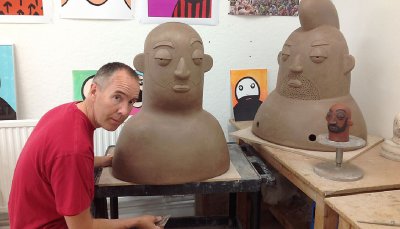 Perfection, I felt, would be living in accord with my life’s mission, doing what I was supposed to do all the time. Even though I had lost faith in the religion of my birth, I still felt that the idea of God was valid. I had seen too many instances of peoples prayers being miraculously answered to discount this reality. Even though I could not see him or her, I always felt that there was an approachable agent of divinity that heard when we called. I also instinctively felt that this divinity was in each one of us, and could be heard, if only I could make my mind calm and quiet, I might be able to hear that guidance, like the voice of conscience to offer kind, encouraging and ever supportive guidance.
To this end, I was led half way around the world to a meditation workshop where just these skills were introduced to me. Part of a small group of seekers, we were shown exercises in concentration and meditation that when perfected, would allow us to go beyond the restless mind and enter into the silence of the heart.
Since that first workshop, over 20 years ago, I have continued meditating every day and it has undoubtedly changed me as a person. The path I follow is based on the spiritual heart which is a point in the centre of the chest. It is a psychic centre that is the seat of love, oneness and identification with others. My Master, Sri Chinmoy, advises his disciples to meditate on this centre rather than the mind as he feels it is faster and safer for them.
Although others have, I am sure, seen more suffering than I have. In my art-offering to the world, I have no desire to inflict my pain and sadness on other people. I have no desire to produce work that has a social or political message, and I have no desire to control or prescribes people’s experiences and reactions to the work I make. All I can do is offer my love. Before I work, I meditate for a few minutes to make my mind calm and quiet. I enter into my heart where I feel safe, happy, peaceful and grateful. It is from this place that I work. It doesn’t really matter what studio I am in or where I am in the world. If I am in a place that allows me to enter into the heart, then creativity should be able to flow.
Whilst making, my preference is for silence. This allows me to concentrate fully on the task at hand. My art world life I take as a sacred gift, and an integral part of my spiritual life. To do it justice, I cannot work with the radio on or have people chatting near by. For this reason, I have always struggled in shared studios. From the outside it may seem that I am being snobbish or aloof by not wanting to mix with others, but this is not now I see it. I truly love people, but when I am doing something which I find so sacred, fulfilling and rewarding, I want to dive deep within, like during a meditation and not use any of my psychic energy trying to counter any extraneous noises or vibrations. When one is in a meditative state, loud noises and disturbances can be shocking and hurtful, and this is just how I feel when disturbed during making.
Afterwards, I will offer gratitude for being able to do what I love, and these moments also allow me to return to a more normal day-to-day consciousness where I can talk and mix freely with others.
Meditating on the heart does inform what I make. The heart is a centre of simplicity and love, and so works I make tend to be simple, cheerful and even child-like. I always take great delight in looking at young children’s drawings and paintings. They inspire me to see things in a new way, with a child’s eyes, straight from the heart. As I have been drawing and making things for a few years, I have some skills and propensities which make the execution of my heart-felt art a bit tidier than the works of children’s but in no way do I feel they are inferior. A child’s drawing is indeed my idea of perfection in the art world.
Growing up and practicing art at school, it was common to hear other children belittle their own creations thinking that their picture was not good or not worthy of being seen. At times, I too felt the same. Over the years though, I have come to realise that self doubt is not a healthy attitude to have, and I love my pictures and ceramics.
I appreciate that my work may not suit all tastes, but it is the best I can do at the time and I am happy with it. There may be mistakes or blemishes in execution or design but when I finish a piece of work and meditate on it, I also offer it inwardly to God and my Master. For this reason, I feel I can no longer claim it as mine.
Operating in the outer world, I will sign and sell work if possible, as I would like what I produce to go beyond the boundaries of my own existence. I am encouraged when people give me positive feedback on things I have done, as it gives some validation to what I do in the privacy of my studio. However, I cannot depend on the market to inform what I make.
Art is too important and precious to me that I work to commission on someone else’s idea of something. I worked for many years as a technician producing art for public projects and nearly all works were compromised in their integrity whilst fitting around the requests of architects, accountants, planners and clients. As a result I work out of the mainstream, producing exactly what I want prompted by my inner voice.
My preference is to make things that do not exist here on earth. I get precious little joy from copying the things I see around me in a realistic way. As mentioned, I do not enjoy using my mind to accurately portray the things I can see already with my outer eyes. In making a piece of work or drawing, I am looking to bring to this earth something new, which does not exist already. Why copy what has been already done? (I make an exception for students learning from old masters).
Using my imagination, my heart and any glimpses of the higher worlds I might be fortunate to receive, I look to bring down some aspect of truth and beauty from above that will make this world a better place.
I will try and manifest that vision to the best of my ability. It will undoubtedly be shaped by my personality, skills and preferences as an artist and probably end up looking like one of ‘my’ pieces but the inspiration will come from another world, an inner realm which I reach through aspiration.
'Seeker' screened as part of Reykjavik International Film Festival
This year, the Reykjavik International Film festival took place from 28 September to 8 October. Among the films shown was Seeker - a short documentary about Snatak Matthiasson, a student of Sri Chinmoy from Iceland since 1985.
Trailer for Seeker
For many years, Snatak was one of the fastest runners in the Centre, as well as being an exceptionally good singer and pianist. In 2004, Snatak was diagnosed with ALS; over the years he has lost much of the capacity of his upper body, but it has not deterred him from living spiritual life to the best of his ability.
In 2011, Snatak had the inspiration to form a singing group dedicated to singing Sri Chinmoy’s songs in their pure acapella form. The group would go to places of worship of different religions all around the world, to underscore the underlying unity behind all religions. Thus, many of Snatak’s friends from all around the world came together, and the Oneness-Dream singing group was born. The group had their initial concert tour in Iceland, and over the years have toured churches, temples and spiritual places in Finland, Myanmar, Ireland, Scotland and California.
Earlier this year, the group went to the Italian region of Tuscany to sing in the churches and cathedrals there. As you can see from the below slideshow, the group has attained quite a high standard of technical excellence.
Along with the group came Sanjay Rawal, a documentary maker who has worked on award-winning documentaries such as Food Chains (2015), as well as a 2011 documentary on Sri Chinmoy’s weightlifting titled Challenging Impossibility. As a result, a 9-minute documentary titled Seeker was made, which had its first viewing at the Reykjavik Film festival.
Snatak was getting medical treatment in South Korea for much of the festival, but he was able to make it home in time for the last screening of the documentary, and afterwards answered questions for the audience as part of the Q&A session after the film.
Many of the members of Oneness-Dream came to Reykjavik; the day after they held a concert in Frikirkjan, a well known church in the centre of Reykjavik.
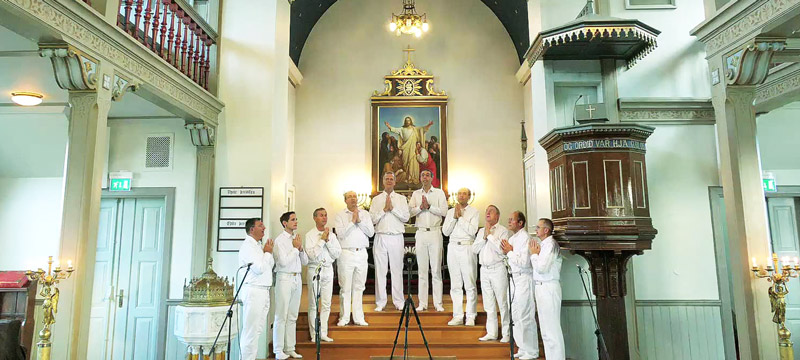
The concert was also used to launch an album, containing recordings from the Italian tour (some of which you can hear in the above slideshow).
“Soulful music is the music that wants to eventually transform our consciousness. It carries us into the Universal Consciousness and makes us feel that we are in tune with the highest, with the deepest, with the farthest.”
– Sri Chinmoy [1]
Related
- Video of Frikirkjan concert on Sri Chinmoy TV
Peace Run in the Faroe Islands
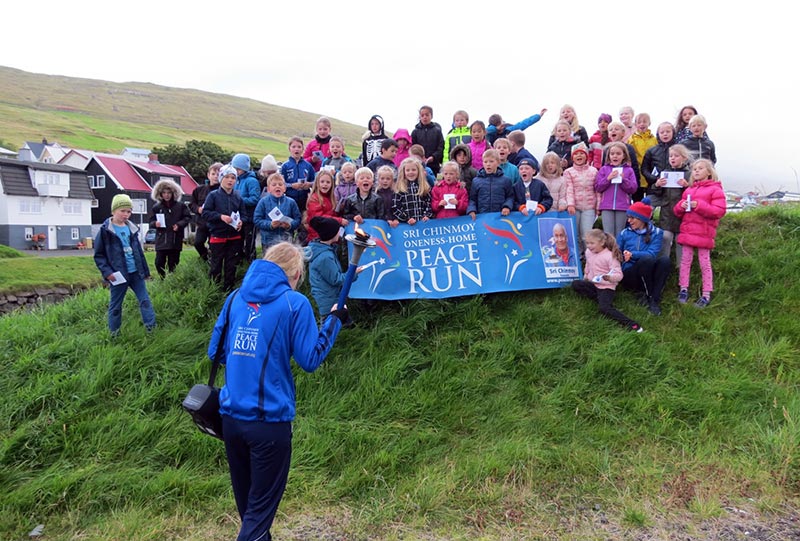
Recently, the Sri Chinmoy Oneness-Home Peace Run visited the Faroe Islands where the runners were warmly welcomed by local dignitaries, local schools and ordinary people from the island.
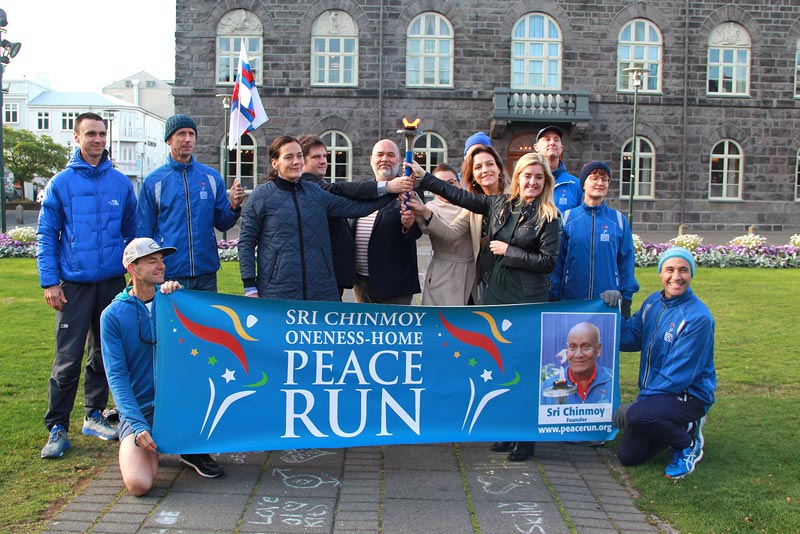
The Faroe Islands is one of 155 countries that the Peace Run has visited, since its inception 30 years ago. During this visit, MPs from Iceland passed on the torch to fellow politicians from the Faroe Islands - sharing a message of peace with its island neighbour.
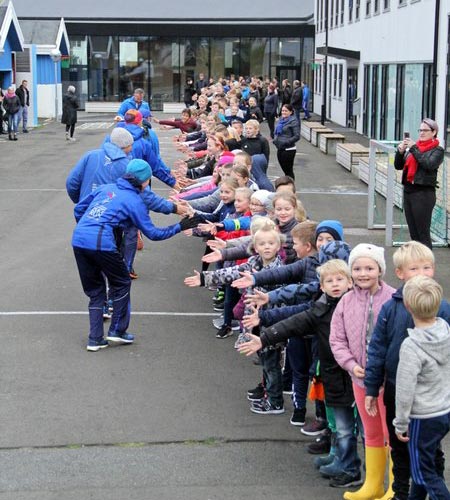
The Peace Run seeks to share a universal message of peace and friendship amongst different peoples of the world. It seeks to celebrate the diversity of the world, whilst sharing the underlying unity of different cultures.
“Peace
Is not the fault-finder
Of the world.
Peace
Is the fault-mender
Of the world.”
Sri Chinmoy [1]
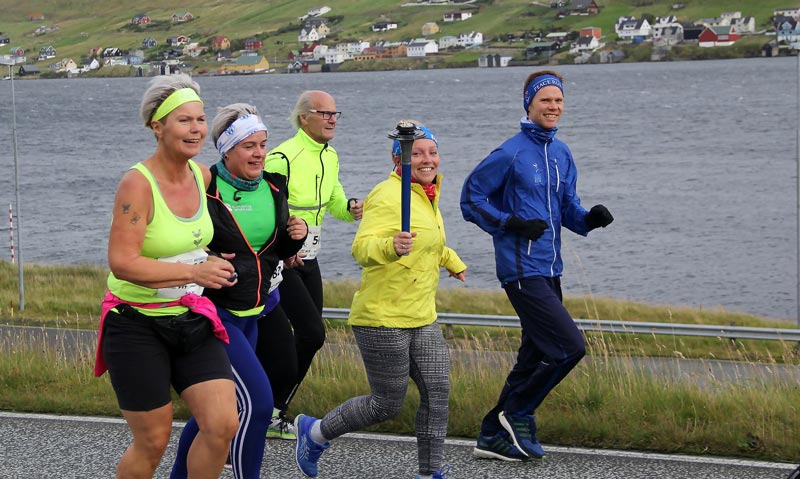
The Run is also a physical challenge with volunteers who support the run, completing the distance between countries on foot - illustrating a tangible way to take this message of peace across the globe.
In this video, some of the volunteer co-ordinators talk about the meaning and significance of the Run and what motivates them to take part in this unique event.
Related
- ‹ previous
- 86 of 337
- next ›

Except where explicitly stated otherwise, the contents of this site are licensed under a Creative Commons Attribution-NonCommercial-NoDerivs 3.0 Unported License. read more »
SriChinmoyCentre.org is a Vasudeva Server project.